‘I Was Untruthful’: Fadiel Adams Confronted at Madlanga Commission – Then Turns Fire on Mkhwanazi
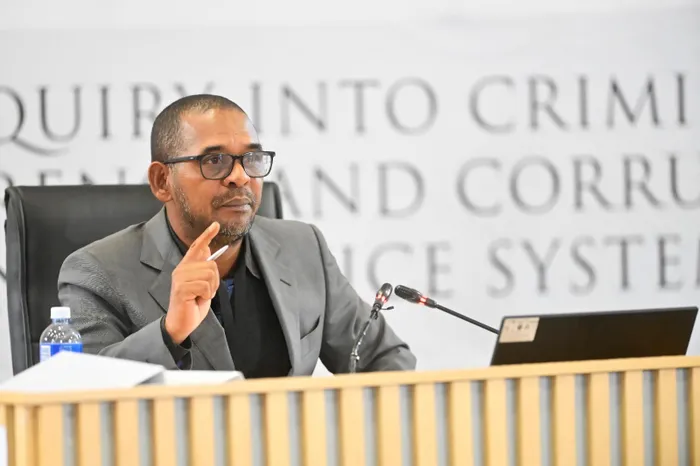
By Mpho Tumelo Modise | Editor-in-Chief, EZA News
JOHANNESBURG – In a dramatic turn of events at the Madlanga Commission on Wednesday, 19 August, Western Cape-based police union leader Fadiel Adams admitted under questioning that he had given “untruthful” evidence to the commission – only to pivot sharply and demand that KwaZulu-Natal Police Commissioner Nhlanhla Mkhwanazi answer for his own alleged links to criminal elements.
Adams’s testimony has become one of the most consequential and combustible threads in the commission’s proceedings. He appeared before the commission after email correspondence was placed before the panel directly contradicting statements he had previously made. Confronted with this documentary evidence, Adams acknowledged the discrepancy and conceded that aspects of his earlier testimony were not truthful.
However, rather than retreating into damage control, Adams mounted an aggressive counter-offensive. He told the commission that Mkhwanazi – the very man whose allegations triggered the commission’s establishment – had his own questions to answer regarding his alleged associations with individuals linked to organised crime. Adams insisted that these allegations deserved the same scrutiny being applied to other witnesses.
To understand why this matters, it is necessary to trace the origin of this commission back to July 2025. On 6 July of that year, Commissioner Mkhwanazi made a series of explosive public allegations claiming that South Africa’s criminal justice system had been infiltrated and compromised. Those claims sent shockwaves through the law enforcement and intelligence communities and prompted President Cyril Ramaphosa to act swiftly, establishing the Madlanga Commission to independently investigate the veracity of Mkhwanazi’s assertions and the broader state of the justice system.
What has unfolded since has been far messier than a straightforward inquiry. The commission has heard competing testimonies from senior law enforcement figures, union representatives, and intelligence insiders – many of them contradicting one another in substance and in detail. Adams’s admission on Wednesday adds a new and deeply uncomfortable dimension: that witnesses before the commission have themselves been less than candid, complicating the panel’s task of separating fact from institutional score-settling.
The commission is expected to continue hearing testimony in the days ahead. Mkhwanazi has not yet publicly responded to Adams’s specific claims made on Wednesday. The implications of Adams’s partial recantation – and whether it affects his credibility as a witness on other matters – remain to be determined by the commission’s leadership.
About The Author