Bassirou Diomaye Faye’s Rise to Presidency: A Turning Point for Africa
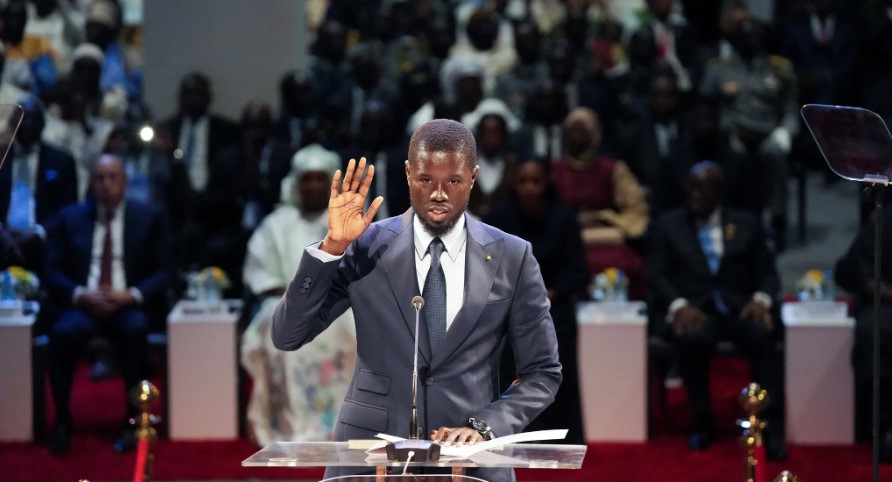
Image source: Newly elected President Bassirou Diomaye Faye takes the oath of office as president during the inauguration ceremony (via Abdou Karim)
Pubished by: Omphile Pule
The youngest president in Africa begins his term, vowing to bring about “systemic change.”
Bassirou Diomaye Faye’s election as Senegal’s president at the age of 44 marks a significant milestone, making him Africa’s youngest democratically elected leader. His win not only serves as a cautionary message to former colonial powers but also inspires young leaders. Faye’s embrace of pro-poor, anti-capitalist policies and his emphasis on national sovereignty and economic renegotiation reflect a broader sentiment across Africa, challenging Western influence.
As Faye represents a growing movement, Africa anticipates a new era of change and self-determination.
The new leader, upon taking the oath of office, pledged to enact “systemic change” and honoured the memory of those who lost their lives, suffered injuries, and were imprisoned during the prolonged period leading up to the election in the West African nation.
Speaking to a large auditorium filled with African heads of state and dignitaries seated at the front, Mr. Faye addressed the crowd, “I will always keep in mind the heavy sacrifices made so as to never disappoint you,” Meanwhile, hundreds of his supporters cheered from the back of the venue and his powerful backer, the opposition leader Ousmane Sonko, shouted for joy.
Hours later, Mr. Faye announced the appointment of Mr. Sonko as prime minister in the new government, as shared in a post on the president’s official account on X.
The appointment marked the climax of months of turmoil, following the former president Macky Sall’s last-minute cancellation of the election, citing irregularities at the constitutional council. However, under immense domestic and international pressure, Sall eventually agreed to proceed with the election.
Despite being a political novice and facing significant obstacles, Mr. Faye secured a decisive victory, garnering over 54 percent of the vote. His opponent, Sall’s chosen candidate, suffered a resounding defeat. Faye’s campaign was notably brief, with only 10 days of freedom before the election due to his prior imprisonment on defamation and contempt of court charges. His release came following Sall’s announcement of an amnesty law.
“You’re Senegal’s uncontested and dazzling choice,” remarked Mamadou Badio Camara, the president of the constitutional council, during the inauguration ceremony, emphasizing Faye’s popular mandate.
However, Mr. Faye wasn’t the sole politician endorsed by Senegal. Mr. Sonko, whose backing played a significant role in Mr. Faye’s election, was seated in the second row during the ceremony.
“Thank you, Sonko, thank you,” shouted his supporters during pivotal moments in Tuesday’s ceremony.
Until recently, Mr. Sonko, Senegal’s leading opposition figure, was also incarcerated, having been prevented from running for president due to convictions on defamation and “corruption of youth” charges related to accusations from a massage parlor employee.
Upon his release, Sonko immediately joined Mr. Faye on the campaign trail, urging his followers to vote for Faye as a vote for him.
While Mr. Faye didn’t mention Mr. Sonko in his speech, the latter remained a constant presence, albeit keeping a low profile in a black hat and tunic. Sonko mingled with African presidents who gathered in an antechamber of a conference center in Diamniadio, a new city still under construction and a project of Mr. Sall.
In the hangar-like room where Mr. Faye would take his oath, Mr. Sonko positioned himself in the second row, just behind the two first ladies—the wives of the polygamous new president. Sonko received thunderous cheers whenever his face appeared on the large screens at the front of the auditorium.
Similar enthusiasm erupted for the military president of Guinea, as well as representatives from Mali and Burkina Faso—three West African nations that experienced coups in recent years and are currently governed by juntas. The rhetoric of these juntas, emphasizing sovereignty from France—the former colonial power perceived by many West Africans as still interfering in their affairs—parallels that of Mr. Sonko and Mr. Faye.
About The Author