President Paul Kagame: World Failed Rwanda in 1994 Genocide
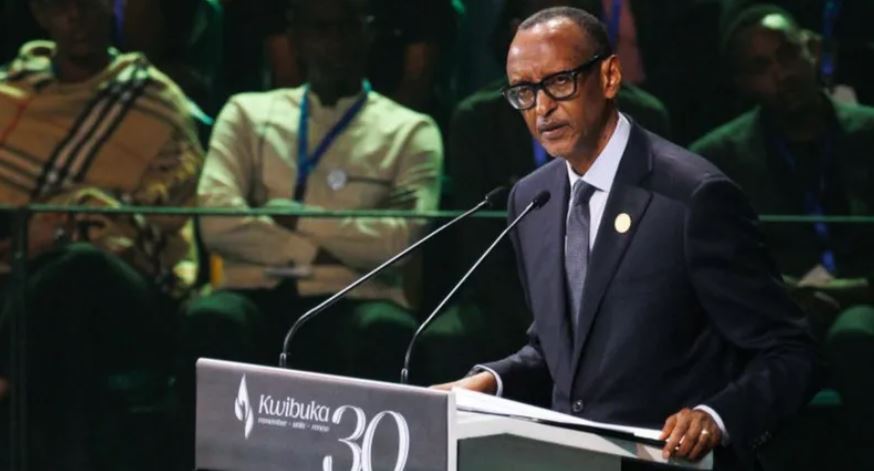
Image Source: Rwanda’s President Paul Kagame (via Getty Images)
Published by: Dimphotsentle Pule
Rwandan President condemns global failure during the 30th anniversary commemoration of 1994 genocide.
President Paul Kagame spoke to dignitaries and world leaders assembled in Rwanda’s capital, Kigali, to remember the tragedy.
“We were deeply saddened by the enormity of our suffering,” he stated. “The painful lessons we gained are etched in our history.”
April, 7th marks the anniversary of the start of the genocide in 1994, when extremists from the Hutu ethnic group initiated a 100-day massacre, targeting both the Tutsi minority and moderate Hutus.
After the genocide, the predominantly Tutsi forces accused of seizing control were accused of retaliatory killings targeting thousands of Hutu individuals in Rwanda. On Sunday, President Kagame, accompanied by dignitaries, laid wreaths on mass graves at the Kigali Genocide Memorial, the resting place for over 250,000 victims. Additionally, he lit a flame in remembrance of those lost.
In a later speech, President Kagame thanked felow African countries like Uganda, Ethiopia, and Tanzania for helping Tutsi refugees and stopping the genocide.
“Many of the countries representing here also sent their sons and daughters to serve as peacekeepers in Rwanda,” he said “Those soldiers did not fail Rwanda. It was the international community which failed all of us. Whether from contempt or cowardice.”
The failure of other countries to help has been a source of lasting shame.
Former US President Bill Clinton, who was among the leaders visiting, has admitted that the genocide was the biggest failure during his time in office.
French President Emmanuel Macron, in a video message for the memorial, admitted that France and its allies could have stopped the genocide but didn’t have the determination to do so.
France, led by President François Mitterrand at the time, had close ties with the Hutu-led government of Juvenal Habyarimana before the killings. Rwanda accuses France of disregarding warning signs and training the militias responsible for the attacks.
French Foreign Minister Stéphane Séjourné represented France at the ceremony in Kigali on Sunday instead of President Macron. Other notable guests included Ethiopian Prime Minister Abiy Ahmed, South African President Cyril Ramaphosa, and Israel’s President Isaac Herzog.
The events on Sunday kick off a week of mourning throughout Rwanda. During this time, radio and TV broadcasts will refrain from playing music, sports, and films, and national flags will be flown at half-mast.
According to reports from the BBC team in Kigali, the city’s streets have been notably quiet, with little traffic, many closed shops, and few people walking around.
The genocide was sparked on the night of 6 April 1994, when Hutu President Juvenal Habyarimana was assassinated – the plane he was on was shot down.
Hutu extremists blamed the Tutsi RPF rebel group, and launched a well-organised campaign of slaughter.
Their victims were shot, beaten or hacked to death in killings fuelled by vicious anti-Tutsi propaganda spread on TV and radio.
Thousands of Tutsi women were abducted and kept as sex slaves.
After 100 days of violence, the RPF rebel militia, led by Mr Kagame, succeeded in overthrowing the Hutu authorities and ending the genocide. Human rights groups allege that RPF fighters were responsible for the deaths of numerous Hutu civilians during their ascent to power, as well as during their pursuit of Hutu militia members who had sought refuge in the Democratic Republic of Congo. The RPF refutes these claims.
Remnants of the violence still persist, with fresh mass graves continually being unearthed across the nation.
Following the genocide, the International Criminal Tribunal for Rwanda was established in Tanzania, where numerous senior officials from the former regime, all of Hutu ethnicity, were found guilty of genocide.
To expedite the trial process for the hundreds of thousands of genocide suspects awaiting justice, Rwanda introduced community courts known as gacaca.
Rwanda claims that hundreds of suspects are still on the run, some hiding in neighboring countries like the DR Congo and Uganda.
President Kagame has received praise for revitalizing the small, war-torn nation with policies that fostered rapid economic development. However, his detractors argue that he suppresses opposition and cite instances where critics have died under mysterious circumstances, both domestically and internationally.
The genocide continues to be a highly delicate topic in Rwanda, with discussing ethnicity being prohibited by law.
About The Author