Update: Jacob Zuma’s Disciplinary Hearing Postponed Amid Safety Concerns
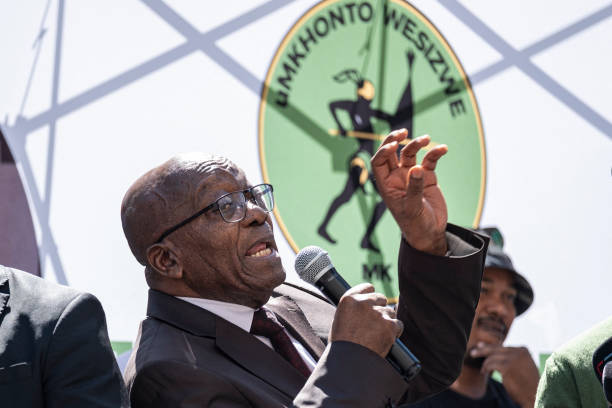
South African President Jacob Zuma addresses members of uMkhonto we Sizwe (MK), a new opposition party that has become a potential upsetter in the South Africa May 29 election, outside the High Court in Johannesburg on April 11, 2024. (Photo by EMMANUEL CROSET / AFP) (Photo by EMMANUEL CROSET/AFP via Getty Images)
South African Former President Jacob Zuma addresses members of uMkhonto we Sizwe (MK), a new opposition party with the potential to upset the South Africa May 29 election, outside the High Court in Johannesburg on April 11, 2024. Image credit: Getty Images, Photo by: EMMANUEL CROSET.
Published by: Rrisang Masenya
Former South African President Jacob Zuma finds himself at the centre of escalating tensions within the African National Congress (ANC), as the party grapples with internal divisions and the looming spectre of national elections. Here’s what you need to know about the latest developments surrounding Zuma and the ANC.
Postponement of the Disciplinary Hearing
Initially slated for Tuesday, Jacob Zuma’s disciplinary hearing has been postponed due to safety concerns, as announced by the ANC. Citing advice warning against large gatherings that could incite violence, the party has opted to reschedule the hearing to a later date, likely after the elections. This decision follows the ANC’s previous intent to discipline Zuma after he denounced the party leadership and pledged support to a newly formed political entity.
Uncertainty and Criticism
The postponement has reignited criticism of the ANC’s handling of internal disputes, with many questioning the party’s decisiveness and consistency. The lack of clarity in the ANC’s stance on such matters has drawn scepticism from political analysts, who see it as a diversion from focusing on the party’s achievements during the election campaign. The shifting format of the hearing, from in-person to virtual, underscores the volatile nature of the political landscape surrounding Zuma’s case.
Legal Objections and Party Dynamics
Zuma’s legal team has raised objections regarding the independence of the disciplinary process, particularly concerning the involvement of ANC leadership. This legal wrangling highlights the complexities of adjudicating internal party disputes within the ANC’s broader political context. As tensions escalate, questions linger about the party’s cohesion and credibility, especially in the midst of a fractured political landscape.
Implications for the ANC and South Africa
The outcome of Zuma’s disciplinary hearing holds significant implications for both the ANC and the wider political landscape of South Africa. Against a backdrop of competing interests and emerging political challengers, such as the MK Party, the ANC faces a critical juncture in maintaining its credibility and unity. The decisions made in the coming days will shape the party’s future and its ability to rally support behind a shared vision for the nation.
Future focus
As the disciplinary process unfolds, all eyes remain on Jacob Zuma and the ANC leadership. The manner in which the party navigates internal divisions and addresses external pressures will determine its standing in South African politics. Whether the ANC emerges stronger from this ordeal or further alienates its supporters remains to be seen. Ultimately, the true measure of success will be the party’s ability to forge a path forward that unites rather than divides.
Jacob Zuma’s postponed disciplinary hearing represents a critical moment for the ANC, with ramifications extending beyond internal party dynamics to the broader political landscape of South Africa. The party’s response to these challenges will shape its trajectory in the days and weeks to come, offering a glimpse into the future of one of Africa’s most influential political entities.
About The Author