Legal Expert Interprets Firearms Control Act in Julius Malema Case
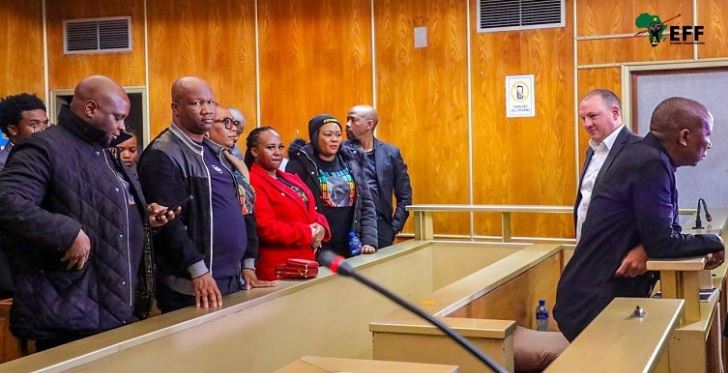
Image Source: The Economic Freedom Fighters (EFF) leader Julius Malema appears in the East London Regional Court in the Eastern Cape on June 18, 2024. Image Credits : X@EFFSouthAfrica
Published by Everything ZA News
East London, South Africa – A defense witness, who is a legal expert, provided crucial testimony in the East London Regional Court, Eastern Cape, regarding the interpretation of the Firearms Control Act. This testimony is a pivotal moment in the trial of Economic Freedom Fighters (EFF) leader Julius Malema and his bodyguard Adriaan Snyman.
Martin Hood, the defense witness and legal expert, argued that the Firearms Control Act does not contain provisions explicitly prohibiting the handing over of a firearm to an unlicensed individual. This interpretation could have significant implications for the charges against both Malema and Snyman.
The case stems from an incident in 2018 during the EFF’s fifth anniversary celebrations at a stadium in Mdantsane, where Malema and Snyman allegedly discharged a firearm unlawfully. Malema faces charges of contravening the Firearms Control Act, while Snyman is charged with handing the firearm to Malema.
Hood’s testimony sought to clarify the legal grey areas within the Act. “The Act has no provisions that make it unlawful to hand a firearm to a person who does not have a firearm licence,” Hood stated. This interpretation challenges the prosecution’s basis for the charges against Snyman and, by extension, Malema.
The defense’s argument hinges on this legal interpretation, suggesting that while discharging the firearm may be an offense, the act of handing it over is not explicitly covered by the current legislation. This distinction is crucial in determining the outcome of the case.
The prosecution has yet to respond to Hood’s testimony. They are expected to argue that the spirit of the law implies a prohibition on such actions, even if not explicitly stated. The outcome of this case could set a significant precedent for how the Firearms Control Act is interpreted and enforced in South Africa.
Malema’s trial has garnered substantial public and media attention, given his high-profile status as the leader of the EFF. The party’s supporters have been vocal in their support, often demonstrating outside the courthouse.
As the trial continues, the court will need to weigh Hood’s expert testimony against the existing legal framework and the prosecution’s arguments. The decision could have far-reaching implications not only for Malema and Snyman but also for firearm regulations in South Africa.
About The Author