DRC and Rwanda Leaders Hold Landmark Talks in Qatar Amid Escalating Tensions
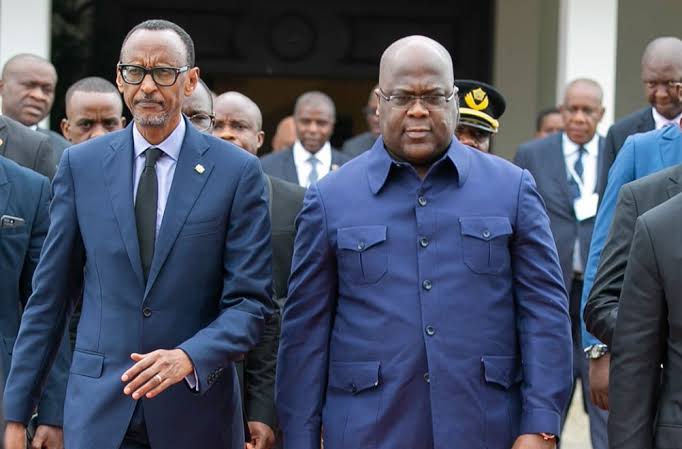
Image source: Business Insider Africa
The leaders of the Democratic Republic of Congo (DRC) and Rwanda convened in Qatar on Tuesday for their first direct discussions since the capture of two key cities in Congo’s mineral-rich eastern region earlier this year by M23 rebels. The group is accused of receiving support from Rwanda. Facilitated by the Qatari government, the meeting showcased the nation’s growing role in global diplomacy.
President Felix Tshisekedi of the DRC and President Paul Kagame of Rwanda participated in the discussions, as confirmed in a joint statement issued by both governments. The emir of Qatar, Sheikh Tamim bin Hamad Al Thani, also attended the meeting, adding to its significance. The state-run Qatar News Agency shared an image of the leaders alongside the emir, marking the event.
During the discussions, both presidents reaffirmed their commitment to an immediate and unconditional ceasefire amid growing regional tensions. However, their joint statement lacked specifics on how the ceasefire would be enacted or monitored, leaving uncertainties regarding the measures necessary for peace.
The summit followed a previous failed mediation attempt between the DRC government and M23 leaders, which fell apart when the rebel group withdrew after the European Union imposed sanctions on its leaders. The ongoing conflict in eastern Congo, exacerbated by M23 activities, has drawn significant global concern and attention.
Qatar’s involvement as a mediator is not unprecedented, as the nation has facilitated peace negotiations in the past, including talks between the Taliban and the United States, Chad’s government and rebel groups, and discussions related to the Israel-Hamas conflict in Gaza.
A diplomat privy to the discussions revealed that Tshisekedi and Kagame had individually approached Qatar for assistance in mediating the talks. The discussions were described as informal, focusing on building trust between the nations rather than resolving all outstanding issues. The diplomat shared this information with The Associated Press on condition of anonymity, citing the sensitive nature of the talks and restrictions on public disclosure.
Peace negotiations between the DRC and Rwanda had been unexpectedly suspended in December, primarily due to Rwanda’s insistence that any agreement include direct dialogue between the DRC government and M23 rebels—a demand that the DRC rejected.
The conflict in eastern Congo intensified significantly in January when M23 rebels, allegedly backed by Rwanda, advanced into the region, capturing the pivotal city of Goma and later Bukavu in February. The M23 group is one of approximately 100 armed factions vying for control in eastern Congo, a region abundant in mineral resources and sharing a porous border with Rwanda. This conflict has triggered one of the world’s most severe humanitarian crises, displacing over seven million people and deepening existing vulnerabilities.
U.N. experts claim that around 4,000 Rwandan troops are supporting the M23 rebels, raising concerns over their potential movement toward Kinshasa, the DRC’s capital, located roughly 1,600 kilometers (1,000 miles) to the west.
In light of the ongoing violence, the U.N. Human Rights Council has established a commission to investigate alleged human rights abuses, including rape and extrajudicial killings, committed by both sides. This effort aims to shed light on the atrocities and ensure accountability for the violations occurring amidst the conflict.
About The Author