
Election Day in Libreville: Gabonese Voters Voice Hopes and Concerns
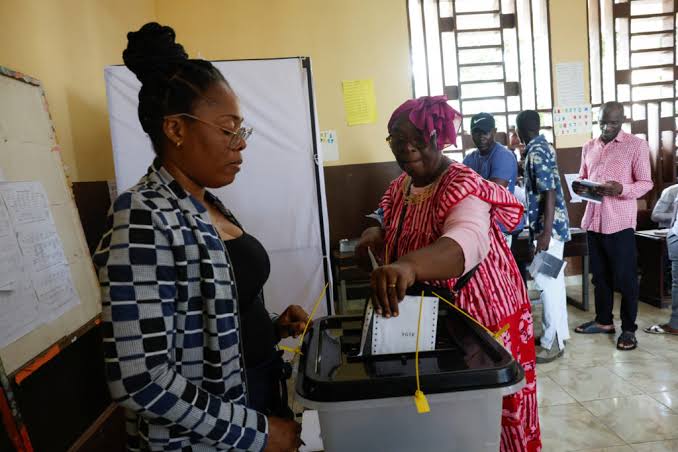
Image source: PBS
Citizens of Gabon, a nation rich in resources on the western coast of Central Africa, took part in a crucial presidential election on Saturday, which the military rulers aim to use to legitimize their authority. This election holds particular importance as it marks the first time since the military coup in 2023 that toppled a political dynasty that had been in power for over fifty years. Analysts anticipate a clear victory for the acting president, General Brice Clotaire Oligui Nguema, who led the coup.
Around 920,000 people are registered to vote, including more than 28,000 citizens living abroad, who will cast their ballots at over 3,000 polling stations throughout the country. Despite its significant oil wealth, Gabon faces profound socioeconomic issues, with approximately one-third of its 2.3 million population living in poverty.
General Brice Clotaire Oligui Nguema, 50, who previously commanded the republican guard, orchestrated the coup that removed President Ali Bongo Ondimba nearly two years ago. Oligui Nguema now aims to consolidate his power and seeks a seven-year presidential term. After the coup, Bongo was initially confined to house arrest but was released within a week due to health issues. His wife and son were later detained and charged with corruption and misappropriation of public funds; however, Bongo himself has yet to face any legal charges.
Oligui Nguema has vowed to “return power to civilians” through what he describes as “credible elections.” Ironically, after naming himself the interim president, he declared his intention to run for president following the parliament’s approval of a new electoral code that controversially permits military personnel to engage in elections. He promotes his candidacy with the slogan “We Build Together,” presenting himself as a unifying figure capable of rekindling hope among the Gabonese people.
The newly approved constitution, validated in a referendum last November, modified presidential terms to seven years—renewable only one time—contrasting with the previous unlimited five-year terms. Additionally, it forbids direct family succession for the presidency and eliminates the role of the prime minister, fundamentally altering the political landscape.
Eight candidates are vying for the presidency, with Oligui Nguema’s most prominent challenger being Alain Claude Bilie-By-Nze, a former Prime Minister under Bongo. In a recent interview with The Associated Press, Bilie-By-Nze called for a significant departure from the entrenched political system, emphasizing the need for “a new independence—political, diplomatic, and economic” for Gabon.
Gabon holds a distinctive position in a region where France is gradually losing some of its long-standing allies among former colonies while still maintaining one of the last close partnerships. The nation continues to host over 300 French troops. Although Oligui Nguema has not indicated a desire to end the French military presence, Bilie-By-Nze has argued that all discussions regarding this relationship should be open, stating, “No subject is off limits.”
Bilie-By-Nze also raised concerns about the fairness of the electoral process, asserting, “Everything has been orchestrated to suppress the vote.” Conversely, Laurence Ndong, a spokesperson for Oligui Nguema, dismissed these claims, asserting that “for the first time, Gabon will experience a free and transparent election.”
On election day, voters showed enthusiasm, lining up early in the capital city of Libreville, where the voting proceeded without any issues. Jonas Obiang, who was waiting to cast his vote in the working-class neighborhood of Damas, expressed his intention to support Bilie-By-Nze, viewing the 2023 coup as a continuation of past political errors.
“General Oligui Nguema is in power with the very individuals who depleted the nation—former associates of the Bongo administration. I refuse to support him,” he stated.
His sentiments were echoed by Antoine Nkili, a 27-year-old unemployed law graduate, who commented, “The choice is personal, but I believe the military has failed. They promised institutional reforms but have instead enriched themselves.”
On the other hand, 57-year-old Jean Bie, a construction worker, revealed his backing for Oligui Nguema, highlighting the swift advancements made by his administration: “In just 19 months, General Oligui Nguema has initiated numerous projects that were long overdue. I’m voting for him, hopeful that he will achieve even more in the next seven years.”
About The Author

