Rights Summit Panelists Demand End to Healthcare System Defunding as SA Marks 30 Years of Democracy
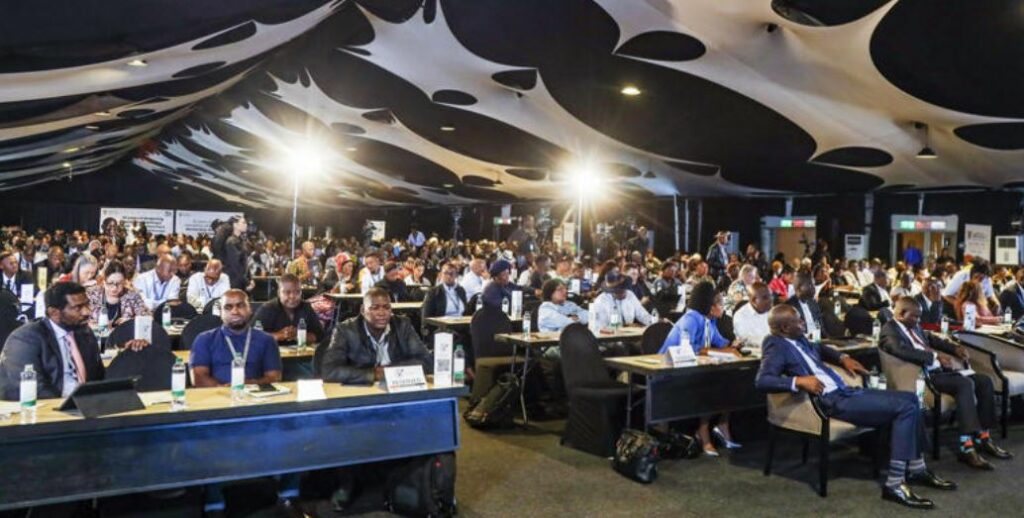
Image source: ‘Stop defunding our health system,’ rights summit panelists say as SA takes stock of 30 years of democracy (Image by Daily Maverick)
Published by: Dimphotsentle Pule
During the Department of Justice and Constitutional Development’s National Human Rights Conference, SECTION27 executive director Sasha Stevenson emphasized the importance of investing in healthcare to combat poverty, inequality, and enhance quality of life. Stevenson stressed the need to cease disinvestment in health, allocate adequate funds, and ensure proper spending to curb corruption.
Stevenson made these remarks during a roundtable discussion on leveraging healthcare and social security to alleviate poverty and enhance living conditions. Despite the transformation of South Africa’s healthcare system since 1994, health facilities remain underfunded and plagued by corruption and mismanagement.
The conference, hosted at the Birchwood Hotel and OR Tambo Conference Centre in Boksburg, brings together government officials, dignitaries, and civil society to assess progress in the fight for human rights. It aims to evaluate further actions needed to ensure all South Africans live with dignity as the nation commemorates 30 years of democracy.
What were the missteps or failures?
Dr. Phophi Ramathuba, serving as the panel facilitator, initiated the conversation on access to healthcare and social security by highlighting the significant progress made in the healthcare sector since the advent of democracy.
She pointed out that before 1994, the homeland system led to fragmented healthcare, which led to disparities in the quality of care and discrimination based on factors such as race, geography, and tribal affiliation.
“But Mandela’s administration was able to amalgamate the different departments of health into one national Department of Health in a short space of time, and that was a breakthrough that needs to be celebrated. What, then, went wrong?” Ramathuba asked.
Health Minister Dr. Joe Phaahla outlined the government’s efforts to revolutionize healthcare since 1994, emphasizing that access to quality health services was an integral part of the struggle for liberation.
Referring to the Africans’ Claims document drafted by the ANC in 1943, Phaahla quoted, “We regard it as a duty of the state to provide adequate medical health facilities for the entire population of the country. We deplore and deprecate the fact that the state has not carried out its duty to the Africans in this regard and has left this important duty to philanthropic and voluntary agencies.” This document called for a significant overhaul of the healthcare system, a mission that the democratic government has embraced and championed, according to the minister.
Phaahla highlighted notable achievements of the democratic era, including former President Nelson Mandela’s announcement that pregnant women and children under six would receive free medical care at all public health facilities. This proclamation was swiftly implemented, and shortly afterward, the government extended free services to all public primary healthcare facilities.
Since 1994, the government has enacted policies to ensure that no one seeking care is turned away from a public healthcare facility, and emergency care cannot be denied to anyone at any healthcare facility in the country, whether public or private.
Huge asset
Reflecting on the past three decades, Stevenson commended South Africa’s current healthcare system, which stands in stark contrast to the apartheid-era system that systematically marginalized large segments of the population, primarily favoring the white minority.
She emphasized the significant assets within the public health system, including training infrastructure and healthcare facilities spanning from primary to specialist levels. Despite acknowledging various challenges and inequalities within the system, Stevenson stressed that South Africa’s healthcare infrastructure is an invaluable asset that positions the country uniquely compared to others, particularly in its pursuit of universal health coverage.
Stevenson highlighted the advantage of South Africa’s combination of a robust public healthcare system, serving the majority, alongside a private sector catering to a smaller portion of the population with medical aid.
Echoing Phaahla’s sentiments, Stevenson underscored the importance of continued improvement in the healthcare system, emphasizing the need to halt the trend of defunding. She criticized the active budget cuts and mismanagement of funds, attributing a significant portion of the health budget to corruption.
Furthermore, Stevenson expressed concern over recent budget cuts, which have resulted in reduced spending per patient in the public healthcare system, ultimately compromising the quality of care provided.
About The Author