President Ramaphosa Signs Electoral Matters Amendment Bill into Law
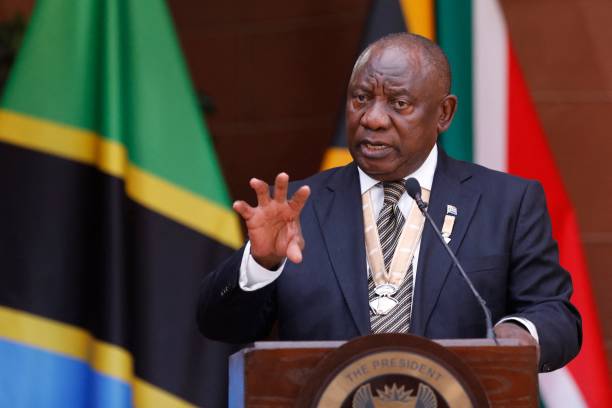
South African President Cyril Ramaphosa (R) speaks during a joint press conference withTanzanian President Samia Suluhu Hassan (not seen) during Hassan's state visit to South Africa at the Union buildings in Pretoria on March 16, 2023. (Photo by PHILL MAGAKOE / AFP) (Photo by PHILL MAGAKOE/AFP via Getty Images)
President Cyril Ramaphosa signs the Electoral Matters Amendment Bill into law, yet another shift in South Africa’s political landscape. Image credit: Getty Images, Photo by: Phill Magakoe.
Published by: Rorisang Masenya
Yesterday, 07 May 2024, South Africa witnessed a significant development in its political landscape as President Cyril Ramaphosa signed the Electoral Matters Amendment Bill into law. This legislation, which was passed by the National Assembly on 12 March 2024 with a vote count of 240 in favor and 90 against, marks a pivotal moment in the country’s governance. By amending the Political Party Funding Act of 2018, this bill has ignited debates and discussions across the nation.
Key Provisions of the Electoral Matters Amendment Bill
The Electoral Matters Amendment Bill introduces crucial changes, particularly regarding the regulation of funding for independent candidates and representatives. By amending existing laws, it aims to align with the Electoral Amendment Act of 2023, which permits independent candidates to contest elections for seats in the National Assembly and provincial legislatures.
Regulation of Funding for Independent Candidates
One of the central provisions of the bill involves the regulation of private and public funding for independent candidates and representatives. This includes the inclusion of independent representatives in the Multi-Party Democracy Fund (MPDF), which raises and distributes donated funds from the private sector to represented political parties.
Opposition Concerns and Criticisms
Opposition parties have voiced concerns about certain elements of the bill, particularly the powers granted to the president in determining the threshold for undisclosed donations. Additionally, changes in the formula for distributing funds in the MPDF have raised eyebrows, with allegations that the new system favours certain political entities, notably the African National Congress (ANC).
Dr. Pieter Groenewald, leader of the Freedom Front Plus, highlighted this issue.
“Previously, the distribution of this fund was based on 90% proportional and 10% equal, although the constitution determines proportionally on an equitable base. Now, this is, as far as we are concerned, not in terms of the constitution because of this distribution, the ANC will receive about 84 to 85% of the total fund, and that does not enhance Multi-Party democracy.”
Dr Pieter Groenwald, FFP leader.
Transparency and Accountability Concerns
Moreover, concerns have been raised about the potential lack of transparency regarding political party funding. While the bill mandates disclosure of donations received by political parties, independent representatives, and candidates, there are apprehensions about loopholes and enforcement mechanisms.
Opposition Reaction and Legal Challenges
Opposition parties, including the Democratic Alliance (DA) and the Inkatha Freedom Party (IFP), have expressed disappointment with the lack of response from the president’s office to their petitions against the bill. This raises questions about the consultation process and the extent to which diverse viewpoints were considered before enacting the legislation.
As South Africa moves forward with this new electoral framework, it is essential to address these concerns and ensure that the principles of democracy, transparency, and fairness are upheld. The upcoming motion in the National Assembly to prevent undisclosed donations to political parties signifies a step towards accountability. However, robust mechanisms for oversight and enforcement will be crucial in safeguarding the integrity of the electoral process.
In the words of President Ramaphosa, “In a year in which voters are presented with the greatest diversity of electoral choice, the legislation that is now enacted constitutes tangible, material support for a vibrant, competitive, open, and equitable electoral system and democratic culture.”
As South Africa navigates through these legislative changes, critical analysis and constructive dialogue will be imperative in shaping a political landscape that reflects the aspirations and values of its people.
About The Author