MK Party Defends Zuma’s India Trip as Lamola Warns of Diplomatic Fallout
By Mpho Tumelo Modise | EZA News
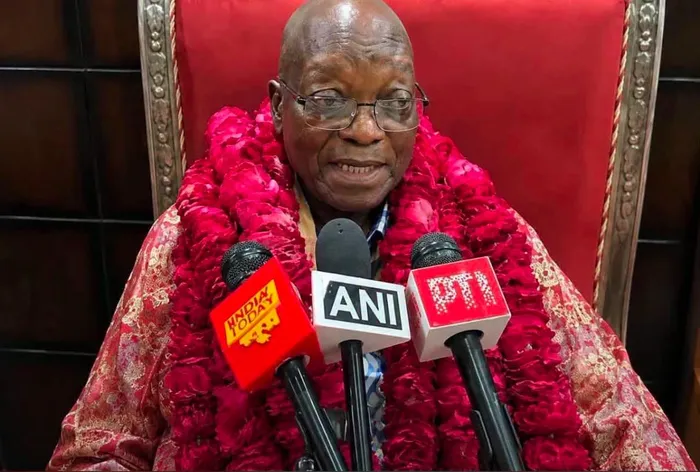
The uMkhonto weSizwe (MK) Party has come out in defence of former president Jacob Zuma following widespread criticism over his visit to India in late June, during which he was photographed alongside Ajay Gupta at the Siddhpeeth Shri Dakshin Kali Mandir in Haridwar, Uttarakhand.
MK Party secretary-general Sibonelo Nomvalo, speaking to Newzroom Afrika, dismissed calls for the party to account for the visit, insisting that the trip was undertaken in Zuma’s personal capacity and bore no connection to the MK Party’s political activities.
“We said the trip to India was a personal visit by the president. The fact that he’s the former head of state does not preclude him from visiting any area in the world, so he went there to visit, and it was a private visit,” Nomvalo said.
He further argued that individuals – including former heads of state – are entitled to privacy and freedom of movement. “Everyone has a freedom to privacy. Next time you will ask us what people do when they are in a restroom and we must be accountable for that,” he said.
Nomvalo elaborated that the purpose of Zuma’s visit was to meet leaders of a religious society in India and that the MK Party had no involvement in or knowledge of the encounter with Gupta. “A trip to India is a trip of President Zuma. He went there to attend or to visit some leaders of a religious society in India. So we’ve got nothing to do with that as the party,” he said.
The Gupta family – brothers Ajay, Atul and Rajesh – remain at the centre of South Africa’s state capture narrative, widely implicated in the systematic looting of state entities during the Zuma presidency. While none of the brothers have been extradited to stand trial in South Africa, multiple investigations and commissions – most notably the Zondo Commission – have detailed their alleged influence over government appointments and procurement processes.
Zuma himself described the Gupta reunion warmly. Reports indicate he referred to Ajay Gupta as a “brother and friend” and noted that Gupta had introduced him to a man of God, expressing hope that the spiritual encounter would assist him electorally ahead of the November 2026 local government elections.
The political fallout was swift. Minister of International Relations and Cooperation Ronald Lamola issued a caution, warning that Zuma’s visit risks undermining South Africa’s official diplomatic processes – a significant rebuke given South Africa’s carefully maintained foreign policy posture on sensitive geopolitical matters.
The visit has reignited a broader debate about the line between private conduct and public accountability for former leaders whose decisions continue to have national consequences.
About The Author